// article
A World Map of Drinking
A world map of drinking, and what the colors give away
Where you live predicts what is in your glass better than almost anything else about you. The FiveThirtyEight alcohol table covers 193 countries, and once you put it on a map the pattern is not subtle. Beer, wine, and spirits each own a part of the world, and the borders between them are old.
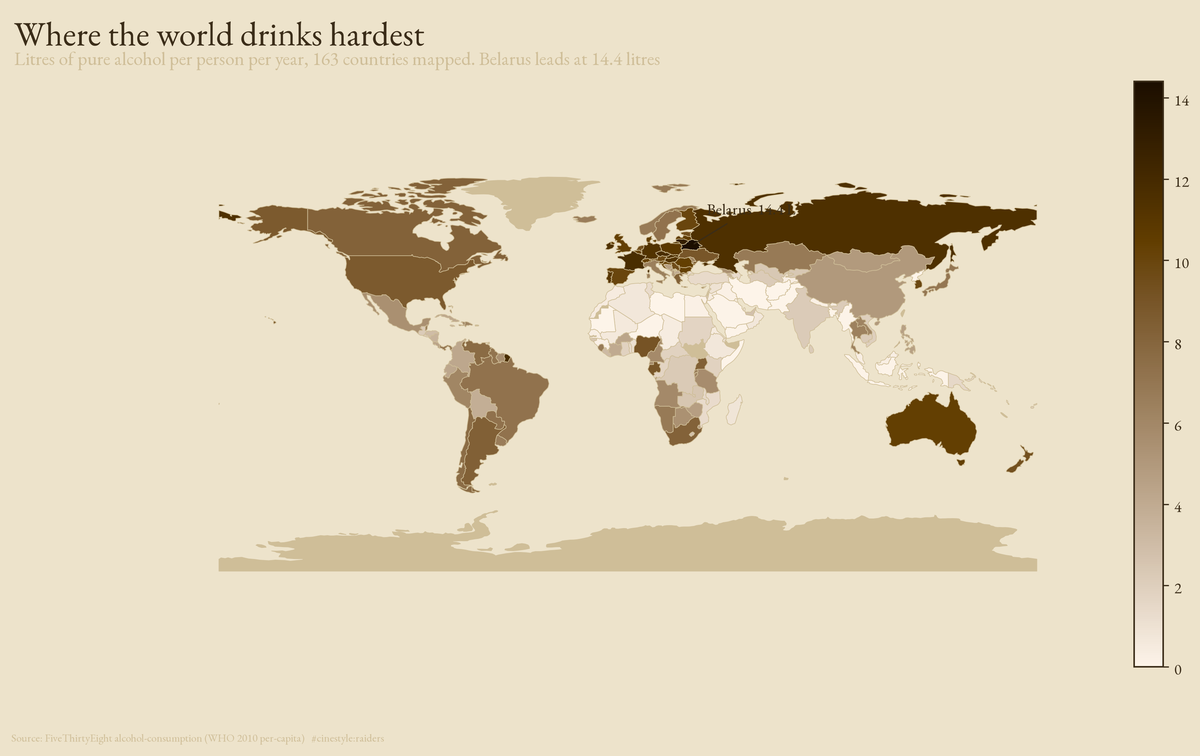
That map shades each country by total pure alcohol per person per year. The dark band runs straight across Eastern Europe and into Russia. Belarus sits at the head of it, 14.4 litres a year, the heaviest-drinking country in the table. The pale countries are the Muslim-majority belt across North Africa, the Middle East, and South Asia, where the number drops to zero. The world average is 4.7 litres. The top ten all clear 11.
The data is one row per country with four numbers: beer servings, spirit servings, wine servings, and total litres of pure alcohol, all per capita from the WHO 2010 figures. No time dimension, no cleaning saga. It is a snapshot, and a snapshot is enough to see the belts.
What wins where
Switch from how much to what kind and the map sorts itself into three blocks.
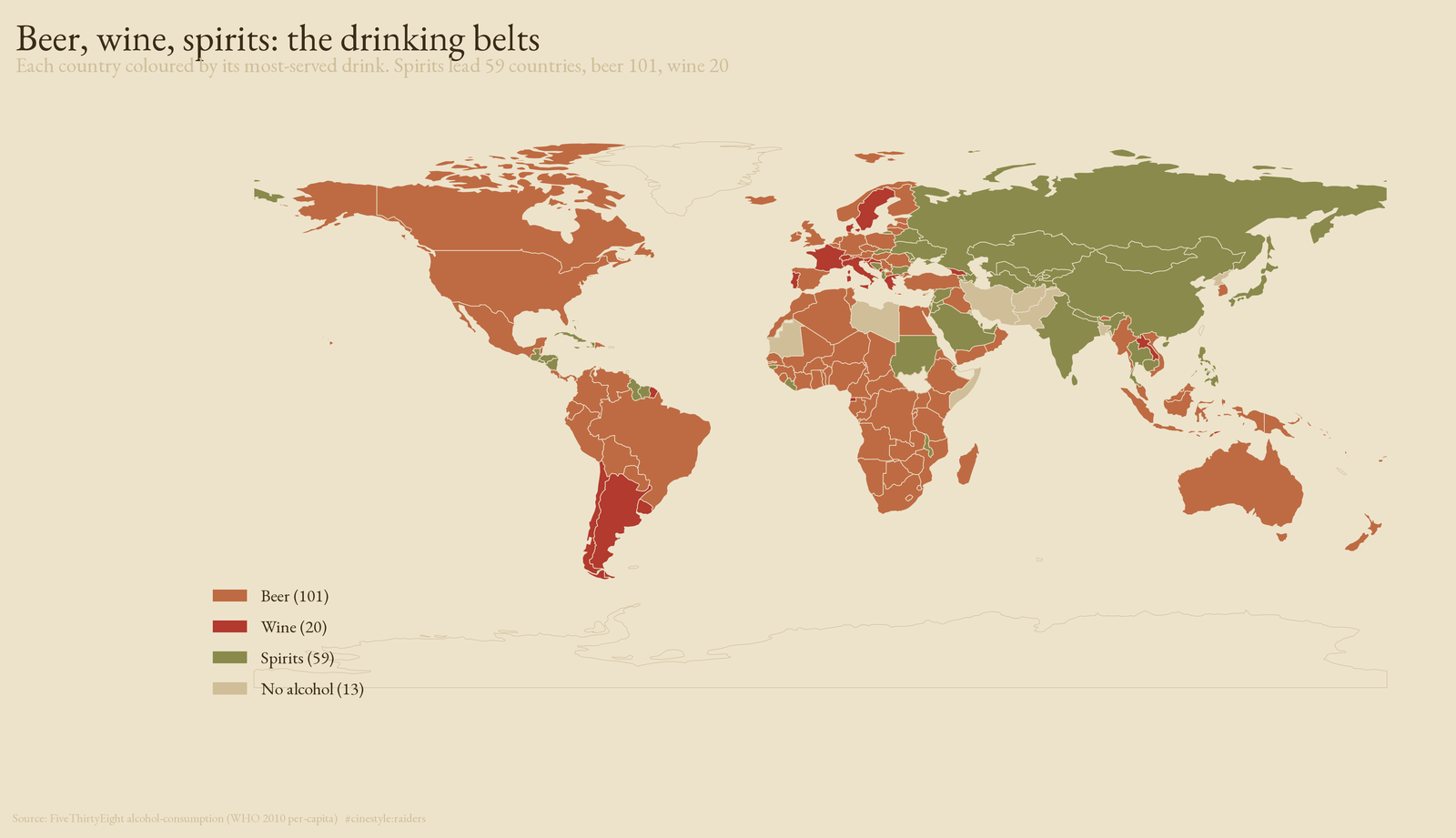
Color each country by its most-served drink and the result is three continents of habit. Beer leads in 101 countries, more than half the table: the Americas, most of Africa, Australia. Spirits lead in 59, and they cluster, the post-Soviet bloc, a stripe through East and Southeast Asia, a scatter of Caribbean islands. Wine leads in just 20, and you can almost draw the old Roman map from them, France, Italy, the Iberian and Balkan coasts, Argentina, Chile. Thirteen countries report zero servings of anything.
The belts are not about taste alone. Spirits travel and store well in cold places where grapes will not grow, beer follows grain agriculture, wine follows the latitude where vines thrive. The map is a climate map wearing a different coat.
The heaviest drinkers, and the world average they leave behind
The total-alcohol leaders are worth ranking on their own, because the gap between them and everyone else is large.
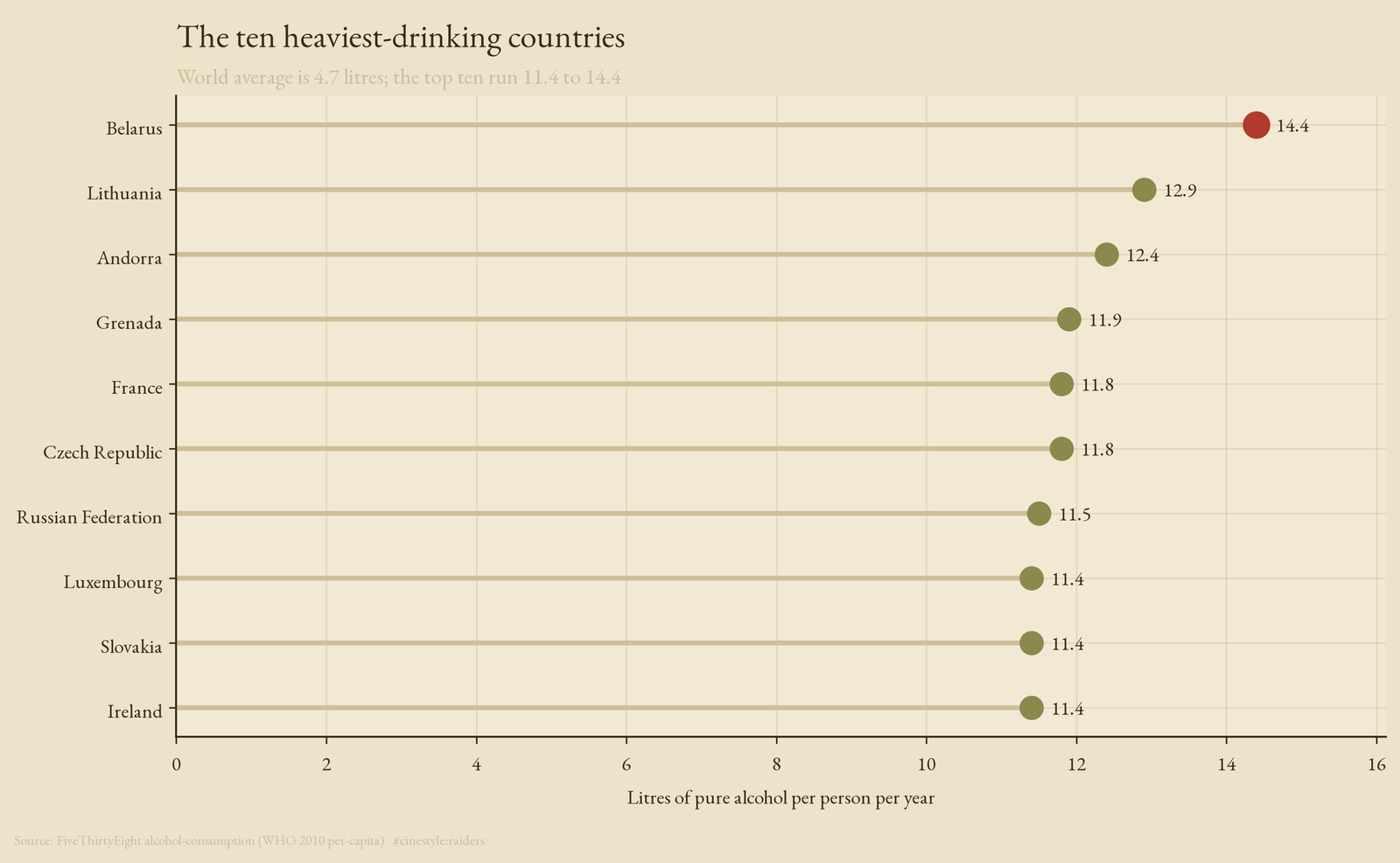
Belarus tops it at 14.4 litres, then Lithuania at 12.9 and Andorra at 12.4. The bottom of this top ten, Ireland, still reads 11.4. Every one of these countries drinks more than twice the world average of 4.7. Nine of the ten are European, and the one that is not, Grenada, is a rum economy in the Caribbean.
A ranking flattens the interesting part, which is that these ten reach the same height by very different routes. Belarus gets there on spirits, France on wine, Ireland on beer. The total is the same shape; the contents are not.
Same height, different glass
So the last view holds the total roughly fixed and looks at the mix.
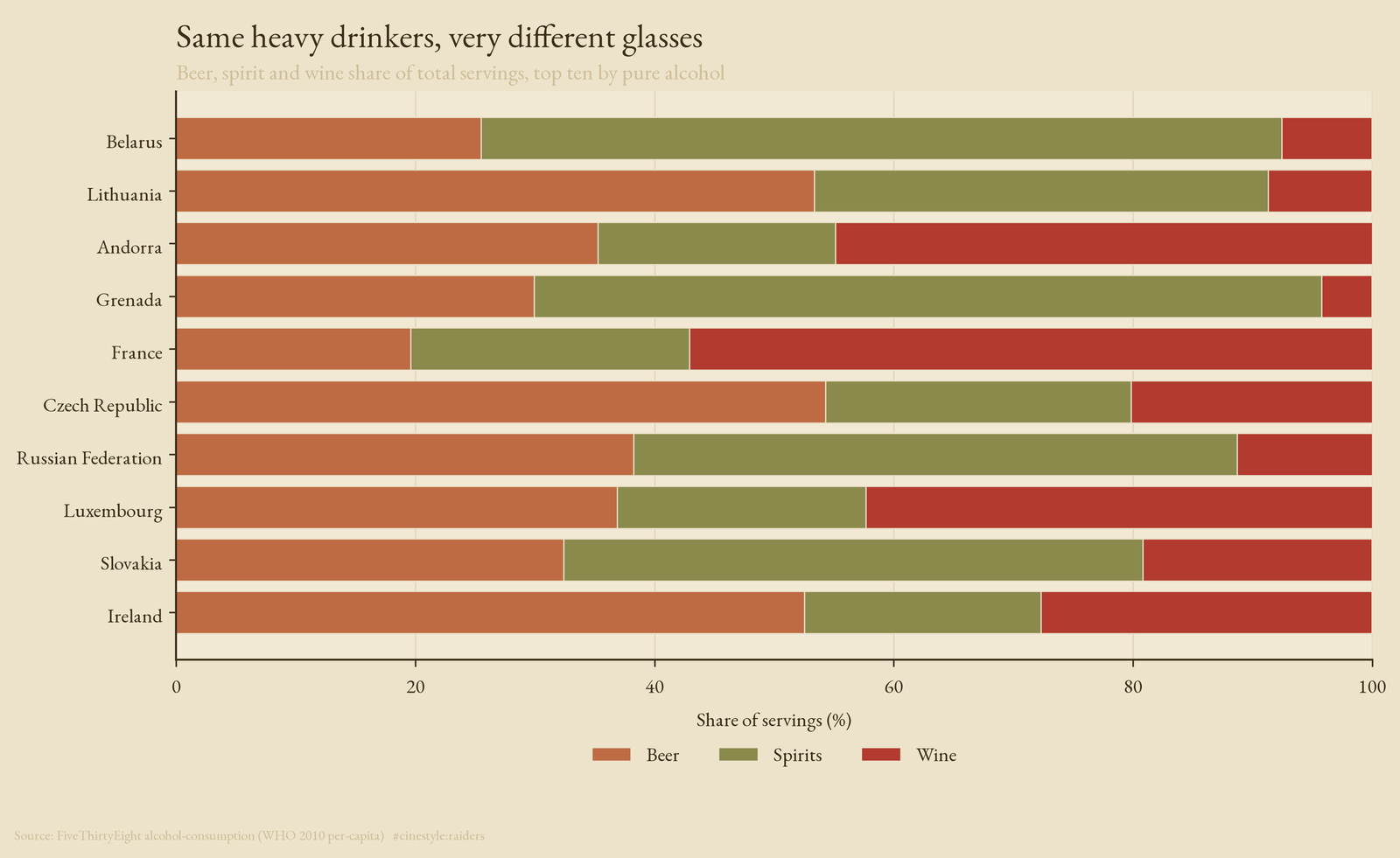
This is the same ten countries, each bar normalized to its share of servings. The variety inside a narrow band of total consumption is the whole point. Belarus and Russia lean spirit. France, Andorra, and Luxembourg lean wine. Ireland, Lithuania, and the Czech Republic lean beer. Three countries, three glasses, almost the same number of litres at the bottom of each.
The single-drink records make the same case at the extremes. The heaviest beer country is Namibia at 376 servings. The heaviest wine country is France at 370. The heaviest spirits country is Grenada at 438. None of the three is the overall leader, because being the hardest-drinking country and being the most committed to one drink are different achievements.
The caveat I owe you
This is a 2010 snapshot, and national drinking habits have shifted since. It is also per capita across the whole population, so a country with many abstainers and a hard-drinking minority reads the same as one where everyone drinks moderately. And the map drops countries: 30 of the 193 rows are microstates and island nations that the 110m Natural Earth layer does not carry, so Grenada, Andorra, and the Caribbean rum islands appear in the rankings but not on the world map. The 163 countries that do map are enough to show the belts; the missing ones are too small to see at world scale anyway.
I came to this expecting a chart about how much. The more honest story was about what. The amount of alcohol a country drinks tells you something about its winters and its wealth. The drink it reaches for tells you where it sits on the old map of grain and grape, and that map has barely moved.