// article
How Steam Games Fade
The biggest games on Steam, and how fast the rest fade
SteamCharts tracks more than a thousand Steam games a month, and almost nobody is playing most of them. In February 2021, the top game held 17% of all concurrent players, and the median tracked game had 300 people online at once. The platform looks like a thriving crowd. It is really a handful of permanent fixtures and a long, thin tail of games dying in public.
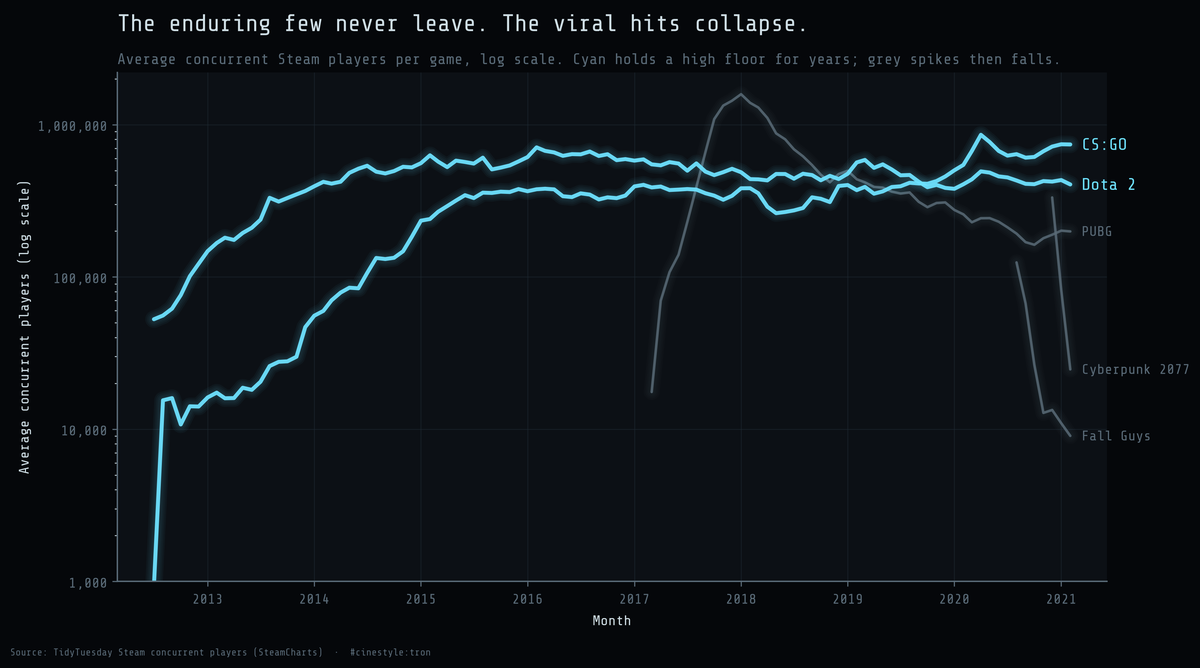
The two cyan lines are Counter-Strike and Dota 2. They sit near the top for nine years and barely move. The grey lines are the games everyone talked about for a month: PUBG, Cyberpunk 2077, Fall Guys. Each one spikes, then falls off the screen. The rest of this post measures that gap.
The data is the TidyTuesday Steam release: 83,631 monthly rows covering 1,258 games from July 2012 to February 2021, each row a game’s average and peak concurrent players for that month. Steam reports the month as a name, so the first real step is parsing year plus month into a date. After that the columns are clean.
A few games hold almost everyone
Take the most recent month and rank every game by average concurrent players. The shares are brutal.
- Top 1 game: 17% of all players
- Top 5: 37%
- Top 10: 46%
- Top 20: 56%
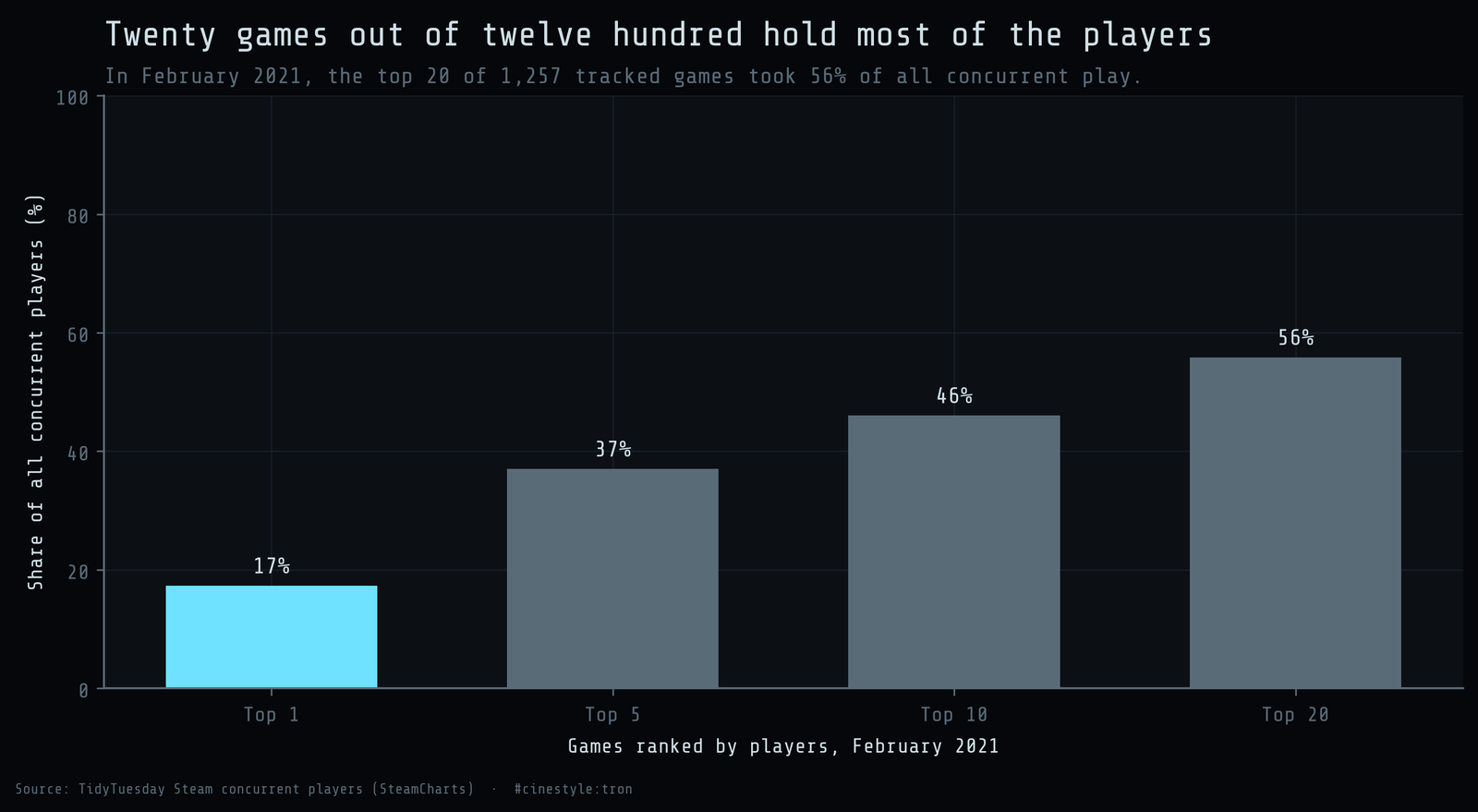
Twenty games out of 1,257 tracked that month carry more than half of all concurrent play. To reach half the players you need exactly 14 games, which is 1.1% of the field. Reaching 80% takes 92 games, and 90% takes 208. The other 98.9% split the remaining half, and they split it thin: the median game sits at 300 concurrent players against Counter-Strike’s 741,013, a ratio of about 2,467 to one. Picture a stadium where one section is packed shoulder to shoulder and the other ten thousand seats hold one person each. Attention on Steam does not spread out; it piles up.
The cliff is the first month
So a few games endure. How fast does the rest of the field fade? For every game with at least 18 months of history and a peak you can actually see (the peak month is not the last month on record), I measured its players as a fraction of its own peak, lined up by months since that peak. That gives 1,042 games on a common clock.
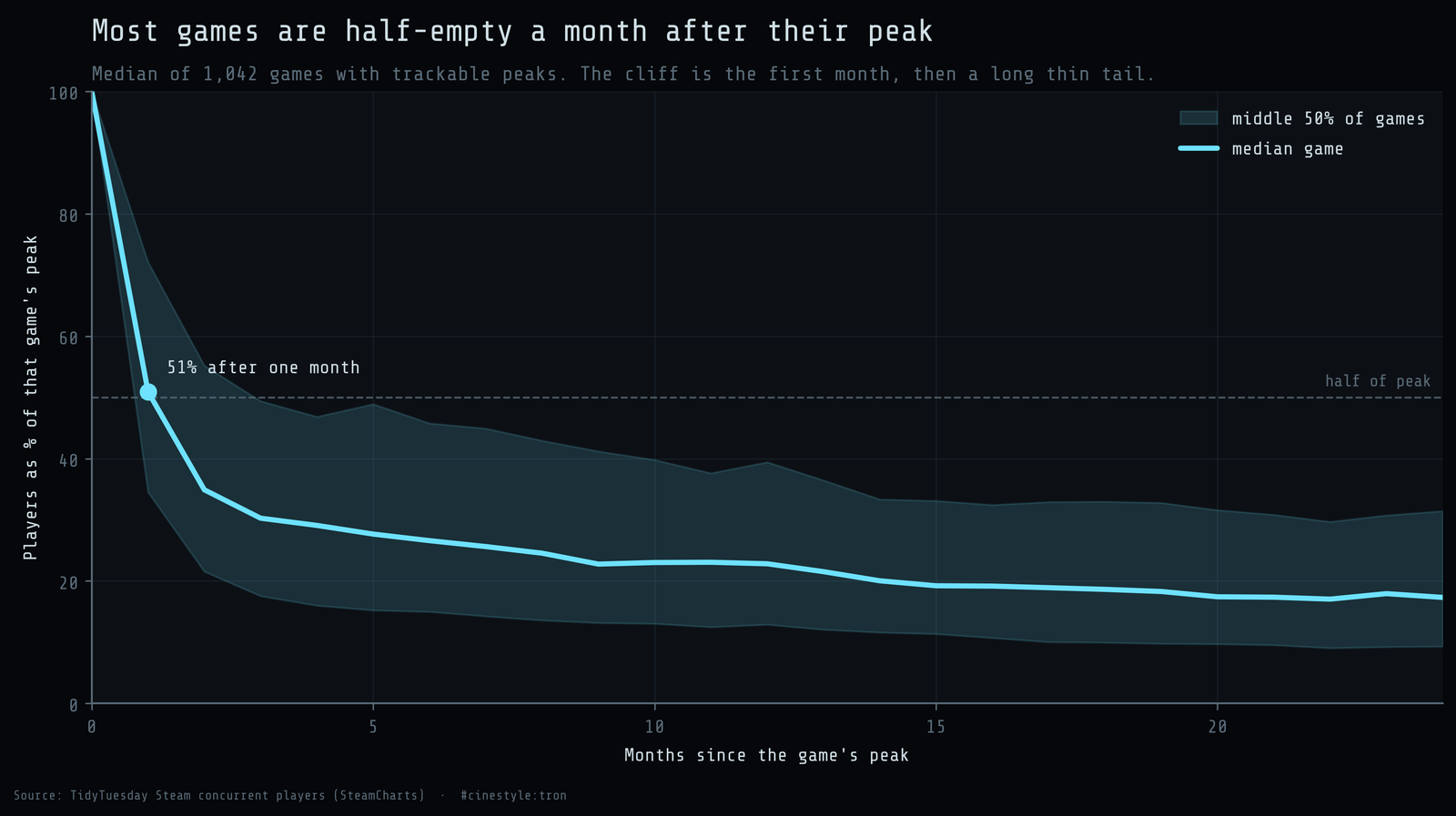
The median game is at 51% of its peak one month later. By six months it is at 27%, by twelve at 23%, by eighteen at 19%, and by two years at 17%. The half-life of the typical game is two months, and most of the loss happens in the first step off the summit. After that the curve flattens into a long thin tail near a fifth of peak, which is the small core of players who stay regardless. The shape is a cliff with a ledge, not a gentle slope.
This is the part that reframes the launch hype. A game can hit a million players and be down by half before the next monthly report prints. The peak is not a plateau you settle onto. It is the single best month, and the average game never sees it again.
What “enduring” actually means
The few that last do not decay on that curve at all. Counter-Strike peaked in April 2020 and was still at 86% of that peak by the end of the record. Dota 2 peaked all the way back in February 2016 and held 57% of its all-time high five years later. Set those against the games that defined a season:
- PUBG: peaked at 1,584,887, fell to 13% of peak
- Cyberpunk 2077: peaked at 332,396 in December 2020, fell to 7% of peak by February 2021
- Fall Guys: peaked at 124,479 in August 2020, fell to 7% of peak by February 2021
PUBG had the single highest peak in the entire dataset, larger than anything Counter-Strike ever posted, and it still shed seven of every eight players. Among these five, size at the peak did not predict whether a game lasted. Endurance is a different trait, and only a handful of games have it.
Lockdown put a record on the board
One event lifts the whole platform at once. Total concurrent players across every tracked game peaked in April 2020, the first full month of pandemic lockdowns.
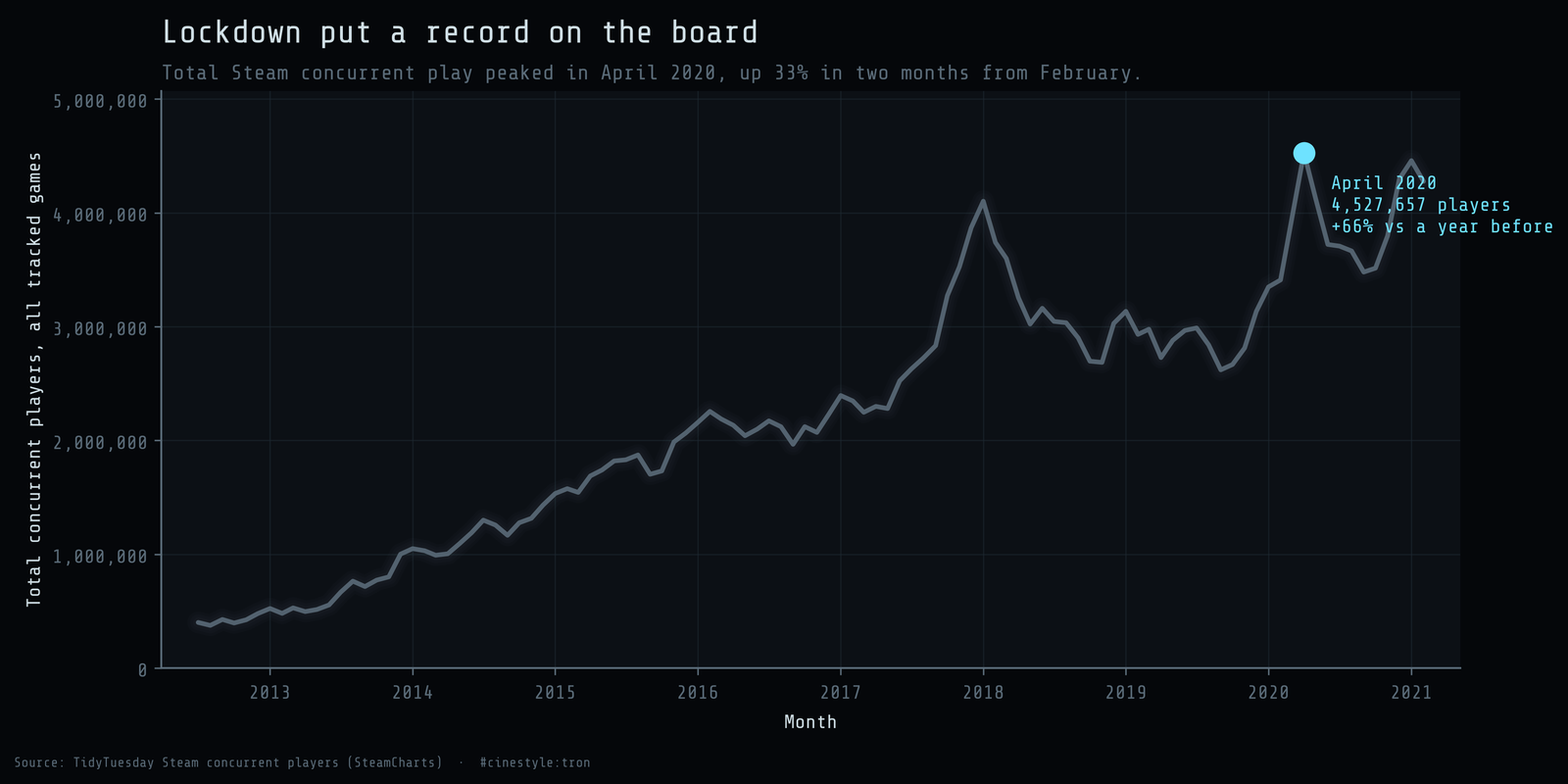
Total play rose 33% in the two months from February to April 2020, and April 2020 ran 66% above April 2019. Counter-Strike’s own all-time peak lands in that same April. The surge is real and it is large: average concurrent players rose by about 1.1 million, from 3.41 million in February to 4.53 million in April. A year later, in February 2021, the total still sat at 4.28 million. Lockdown raised the floor, not just the peak.
The shape of the thing
I went in expecting a popularity ranking. I found steep concentration with a memory. A handful of games hold most of the players and keep holding them for years; the rest spike on launch and lose half their crowd within a month. The mega-games are a different kind of object, the few that turned a launch into a habit.
Three limits. The data is the SteamCharts tracked subset, not all of Steam. Every number is average concurrent players, which counts seats filled at once, not people. And the endurance comparison rests on five games I picked because everyone remembers them.