// article
The Instant Ramen Rankings
The best instant ramen in one reviewer's archive comes from Malaysia, by a nose
A man named Hans Lienesch has eaten and rated thousands of packets of instant noodles, one bowl at a time, and published every score. This is his list: 3,166 rated reviews spanning 44 countries and 454 brands, each graded from zero to five stars. I came to it expecting Japan to win. Japan invented the product; the data says Japan is very good and someone else is slightly better.
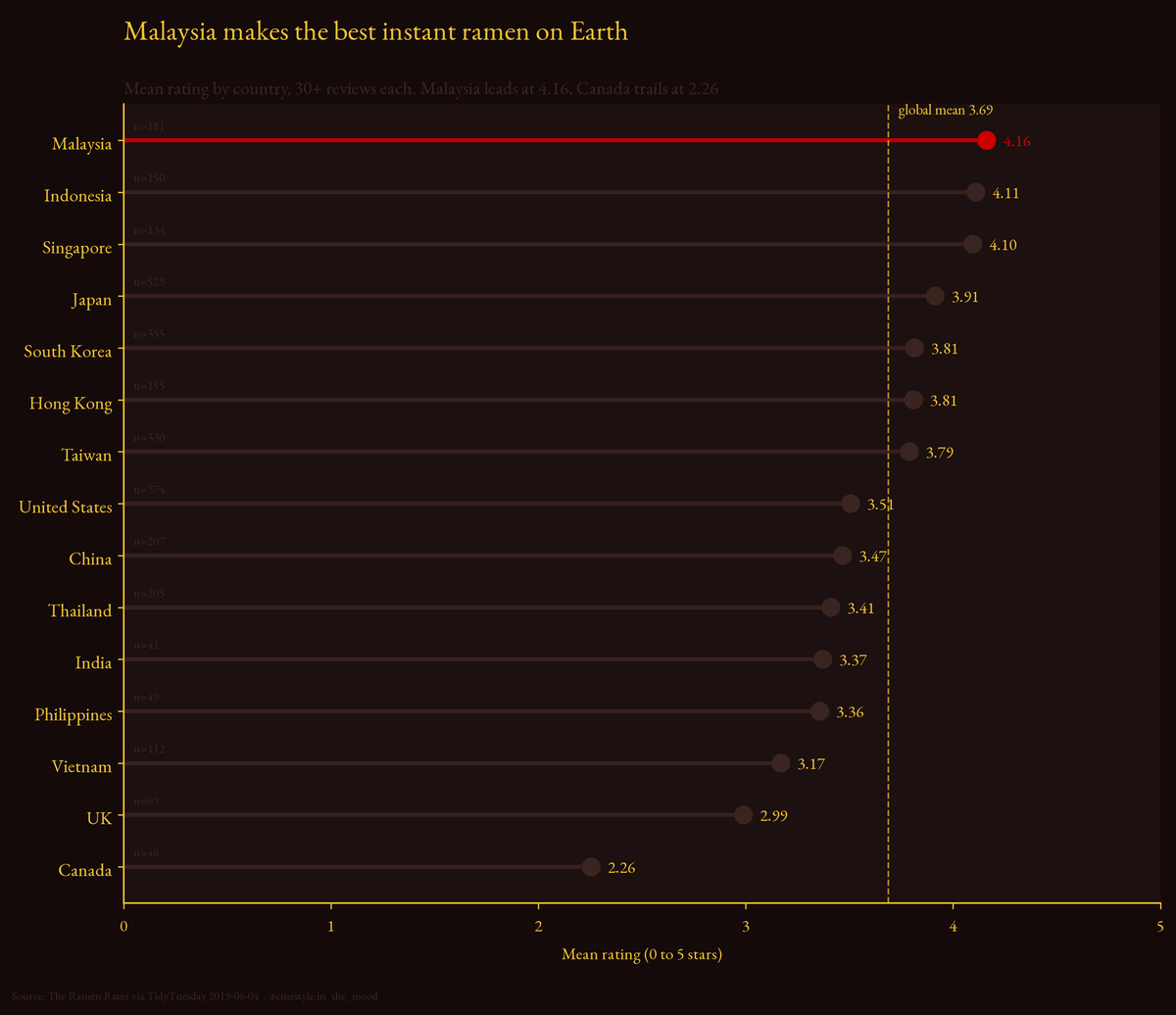
Malaysia tops the table at 4.16 stars across 181 reviews. The rest of this post walks down that ranking.
The dataset is The Ramen Rater’s review archive, pulled via the TidyTuesday project for 2019-06-04. Five columns that matter: brand, variety, the packaging style, country of origin, and the star score. Fourteen rows carried no usable rating, so I dropped them and kept 3,166. No other cleaning. One person’s palate, applied consistently for years, which is exactly the kind of single-rater consistency that makes the comparison fair even if the absolute numbers run high.
Malaysia wins, and the floor is in Canada
Rank countries by mean rating and the top of the board is almost entirely Southeast and East Asian. Malaysia leads at 4.16, Indonesia follows at 4.11, Singapore at 4.10. Those three sit within a tenth of a star of each other, on 181, 150, and 134 reviews, and I did not test whether their order would hold up. Japan sits fourth among the well-reviewed countries at 3.91. The bottom is Canada at 2.26, nearly two full stars below Malaysia. That spread, 1.91 stars on a five-point scale, is enormous for an aggregate of dozens of products.
I filtered to countries with at least 30 reviews before ranking any of them, and that filter is doing real work. The unfiltered leader is Cambodia at 4.20 stars. It has five reviews. Five lucky bowls can put a country on top of a naive leaderboard and tell you nothing about its noodles. Thirty is an arbitrary line, but it is a line, and below it the means are noise dressed as signal. Trust the country that earned its average over 181 bowls, not the one that got there on five.
Reviewers grade on a curve
Before reading any ranking, look at how the scores are spread. The single most common verdict is a perfect five, handed out 528 times, 16.7% of all reviews. The mean lands at 3.69 and the median at 3.75, so the whole distribution is shoved up against the high end.
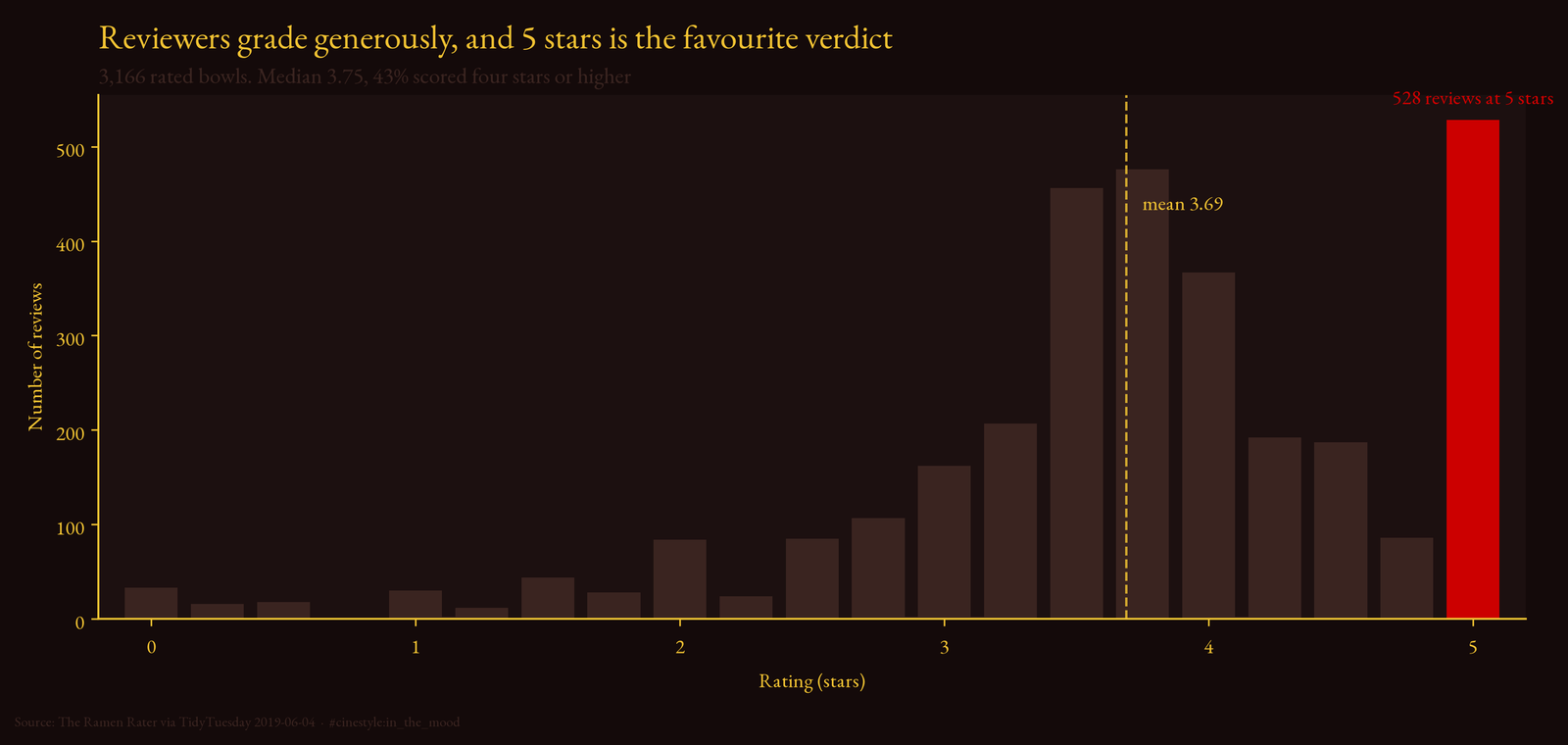
Forty-three percent of all bowls scored four stars or higher. Only 33 reviews out of 3,166 scored a flat zero. This is a generous grader rating food he chose to buy, so the interesting comparisons are not pass versus fail. They are the differences between a 3.5 and a 4.2, and those differences are where the rankings above and below earn their keep.
Packets beat cups, and it is not a fluke
Now the packaging question. Instant ramen comes as a flat pack you cook in a pot, a cup you fill with hot water, a bowl, a tray. If convenience came free, the formats would score the same. They do not.
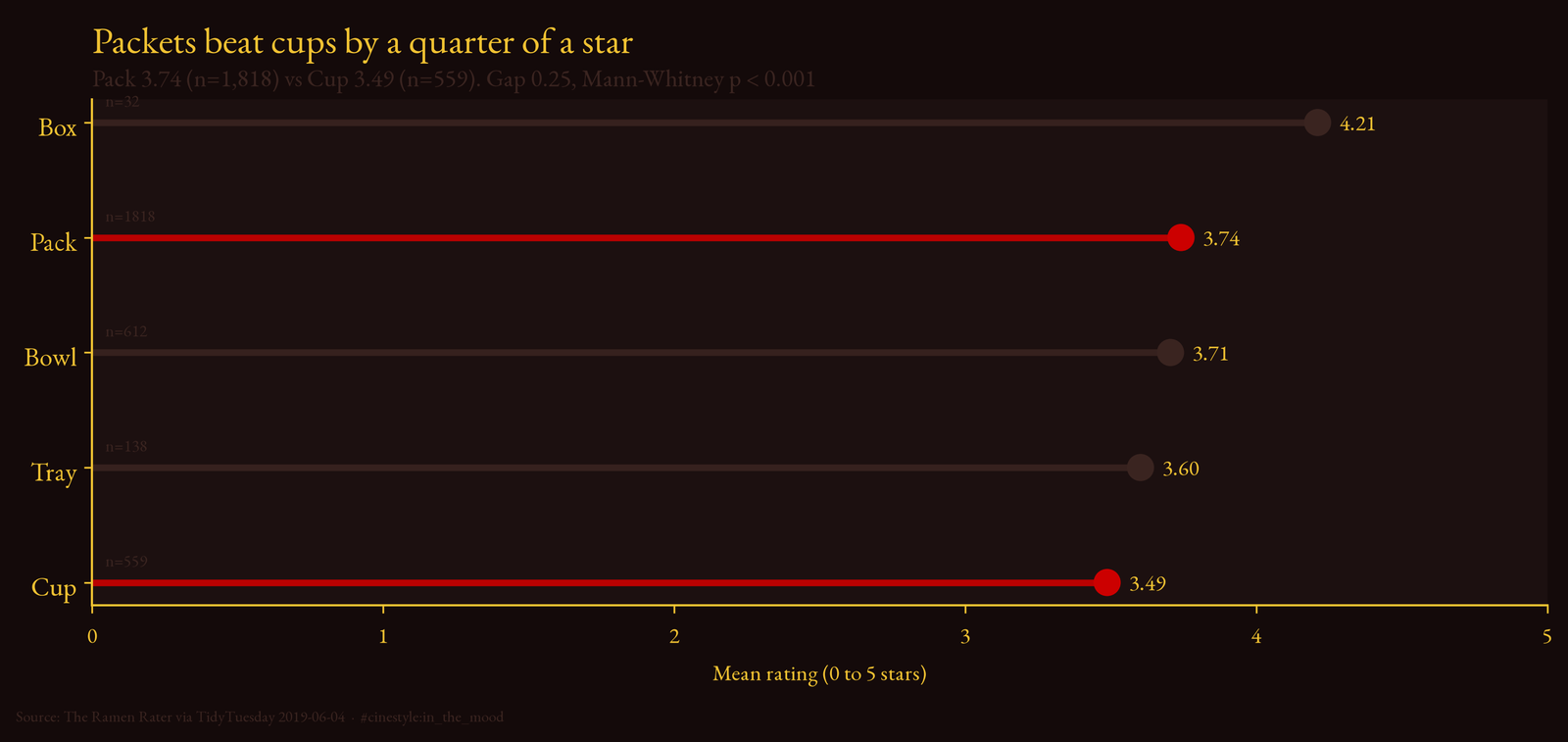
Packs average 3.74 across 1,818 reviews. Cups average 3.49 across 559. The gap is a quarter of a star, 0.25, and a Mann-Whitney test puts the probability of seeing a gap that large by chance below one in a million. The cup trades flavor for not needing a stove, and the scores show the trade.
Packs are not the top format, though. Boxes average 4.21, on only 32 reviews, and bowls sit at 3.71 across 612. My guess at the pack-versus-cup mechanism is the water: a pack cooks in a boiling pot, while a cup steeps in water that is already cooling. I did not control for country, so part of the gap may be which countries sell which format. The gap is real; the reason for it is still my guess.
The brand that almost never misses
Countries and formats are aggregates. The sharpest signal in the whole dataset is a single brand. Filter to brands with at least ten reviews and the leader is MyKuali, a Malaysian maker, averaging 4.95 across 29 bowls.
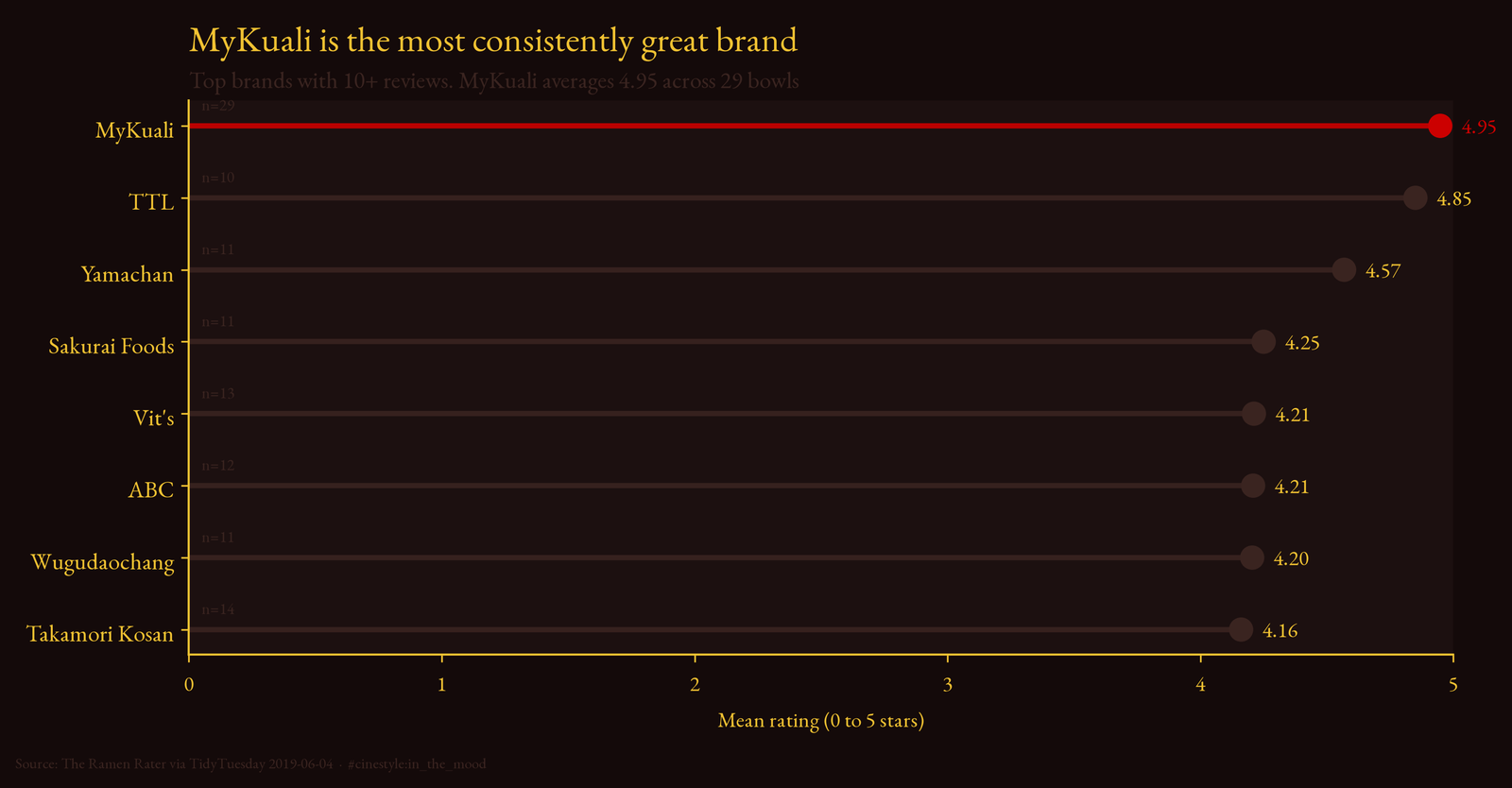
A 4.95 mean over 29 separate reviews means MyKuali was handed a near-perfect score almost every single time. That is not one viral flavour carrying an average. It is a house style that the rater rewarded again and again. Taiwan’s TTL follows at 4.85 over ten reviews, and Yamachan, a US maker, at 4.57. The country crown sits in Malaysia, and so does the best single brand on the list.
What this is and is not
One person tasted all of this. Every number here reflects Hans Lienesch’s palate, not a panel and not a market survey, and a single rater carries habits a crowd would average out. The scores skew high because he is rating noodles he chose to eat. The country counts are uneven, Japan has 529 reviews and India has 41, so a 30-review floor protects the ranking but cannot manufacture precision the small countries do not have. The list also stops in mid-2019, so a brand that has slipped or surged since will not show it here.
Within those limits the picture is steady and it repeats at every level. I expected the inventor to win and the inventor came fourth.