// article
US Health Spending
The US spent $7,194 more per person than Japan and died 7.7 years sooner
In 2020 the United States spent $11,859 per person on health care. Japan spent $4,666. For paying 2.54 times as much, the US got a life expectancy of 77.0 years. Japan got 84.7. The country that outspent everyone finished dead last among the six in the data, by a margin you can measure in years off the end of a life.
That number stopped me, so I went looking for the rule it broke.
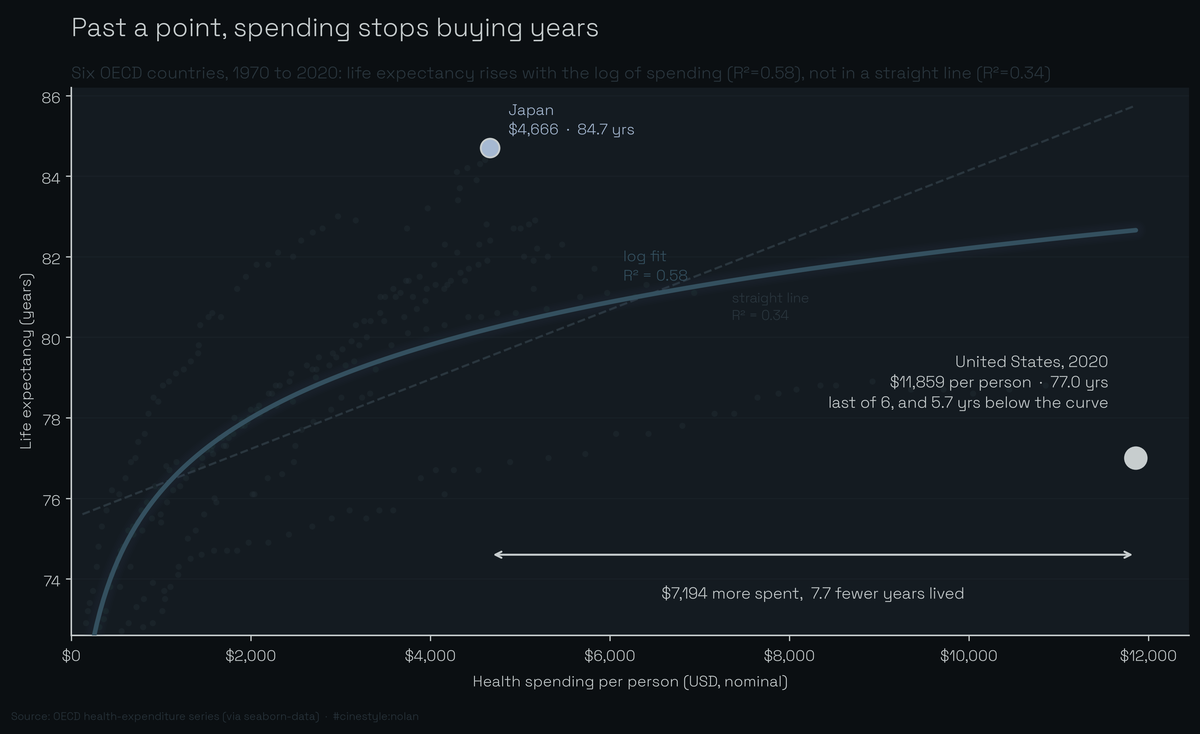
The chart above is the whole argument in one frame. Spending buys years steeply at first, then the curve flattens, and the US has run so far out to the right that the curve has nothing left to give it. Japan, at less than half the spend, is the country sitting where the US should be.
The data is the OECD health-expenditure series that ships with seaborn (load("healthexp"), sourced as “OECD via seaborn-data”). It is small and clean: 274 rows, six countries (Canada, France, Germany, Great Britain, Japan, the USA) running 1970 to 2020. Four columns: year, country, spending in USD per capita, and life expectancy. That is the whole world I get to reason about, and I will say up front it is a thin one. Six rich countries is not a law of nature.
The curve is real, and it bends
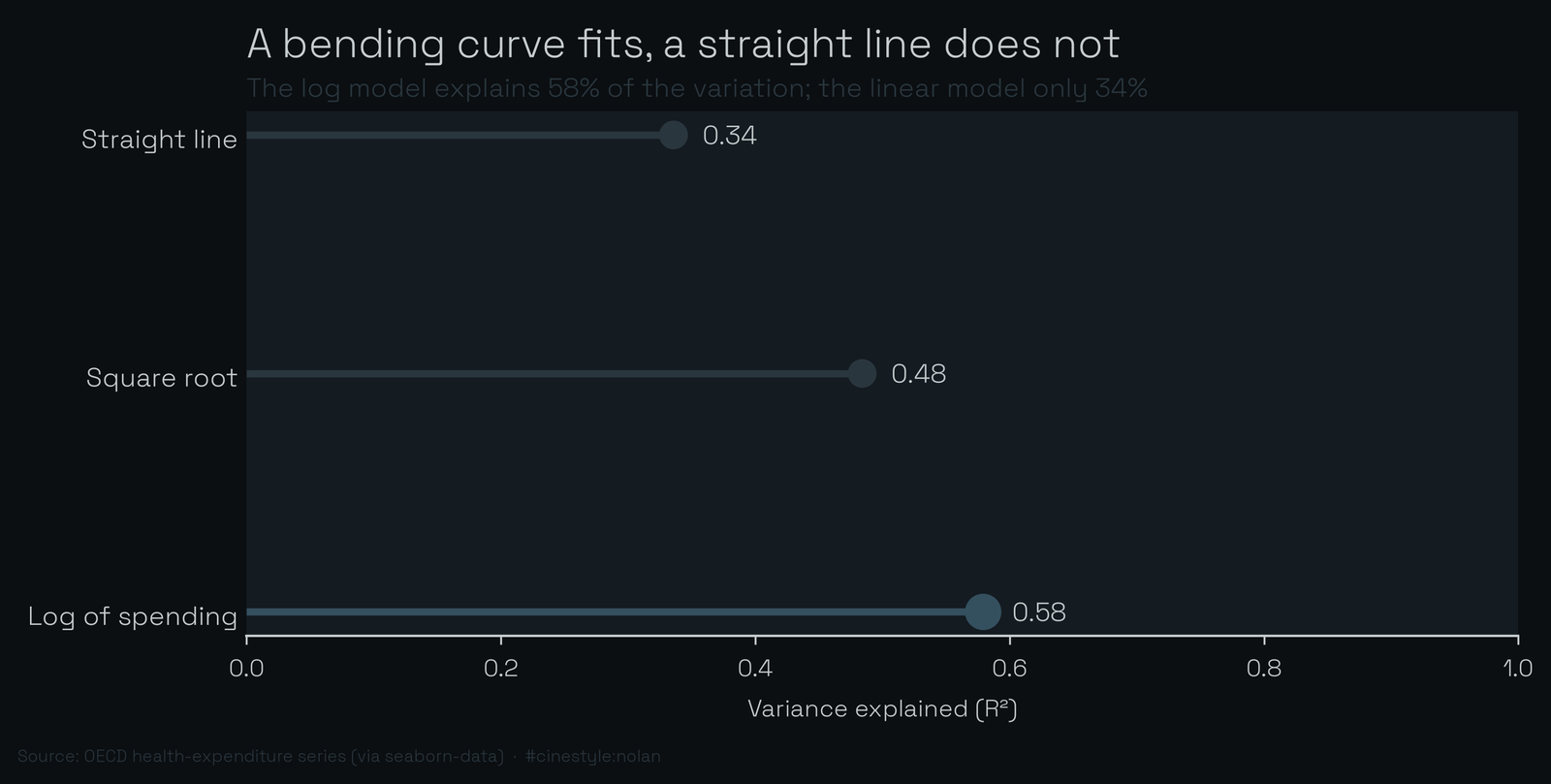
Pool every country-year and plot life expectancy against spending and the shape is obvious before you fit anything: it climbs fast and then flattens. A straight line through that cloud explains about a third of the variance, an R² of 0.34. Swap in a log curve, where life expectancy rises with the log of spending, and R² jumps to 0.58. A square-root fit lands in between at 0.48. The log fit wins because the returns diminish.
You can read the bend straight off the fitted coefficient. The log fit says each doubling of spending buys roughly 1.8 years of life expectancy. That is a doubling, not a fixed dollar amount, and the difference is the whole story. Go from $1,000 to $2,000 per capita and the curve predicts about 1.8 extra years. Go from $9,000 to $10,000, the same thousand dollars but added near the top, and it predicts about 0.28 years. Three months. Same money buys a sixth of the payoff.
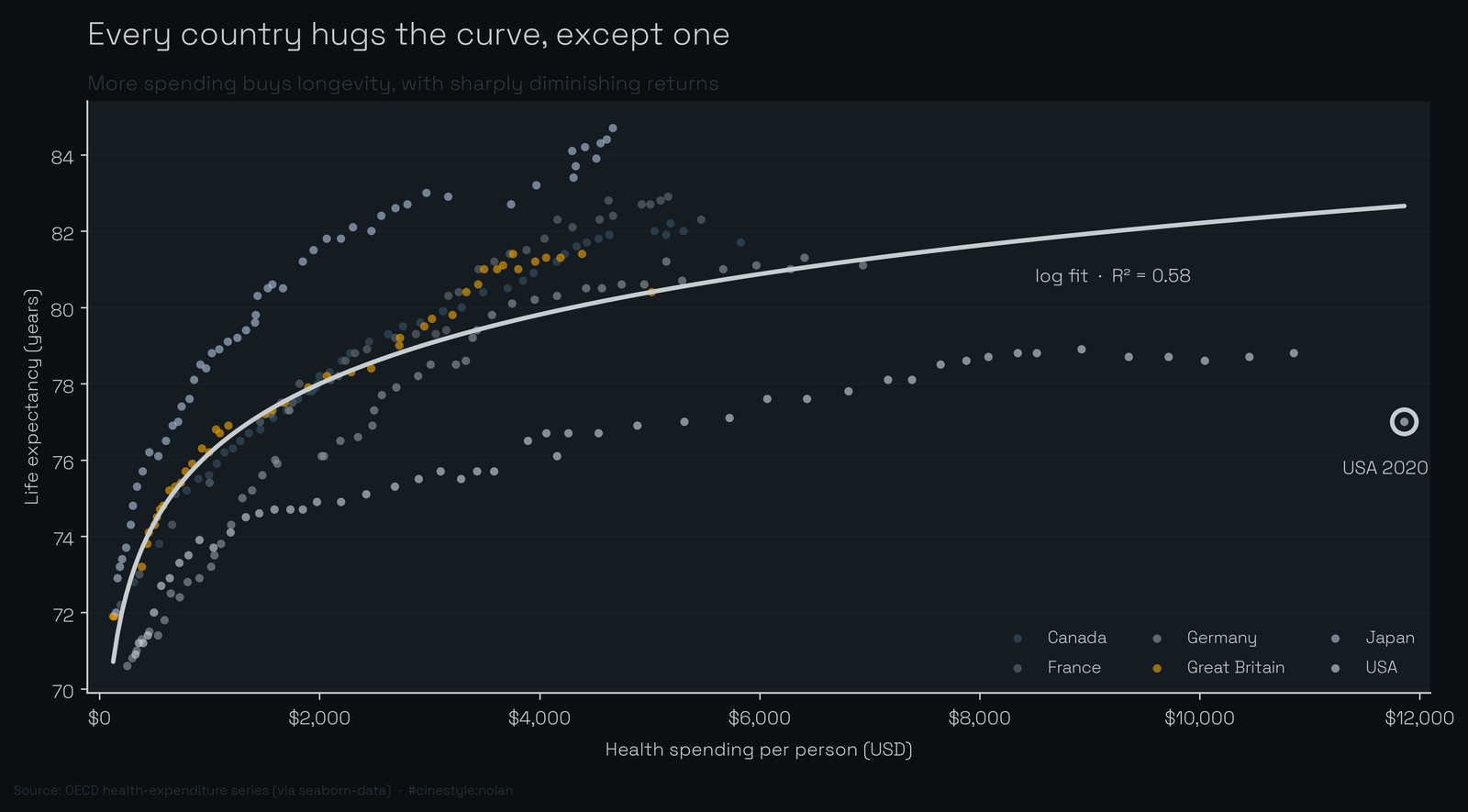
Color the cloud by country and the same shape holds. The fitted line sweeps up and levels off, the country tracks stack along it, and then there is the USA, circled, sitting far out to the right and well below the curve. Everyone else hugs the line. The US is the one country that paid for a seat at the front and ended up in the back.
The outlier, quantified
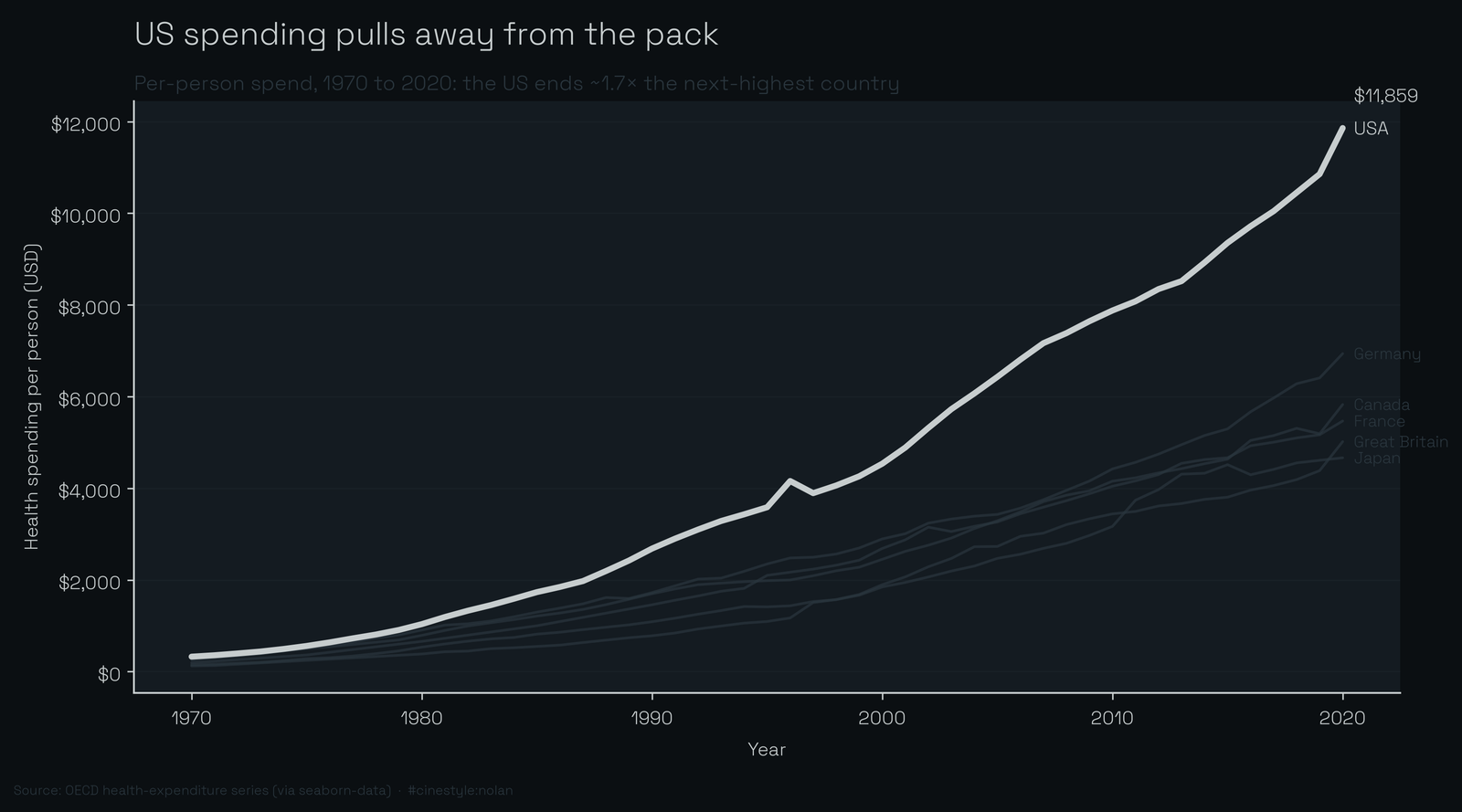
At 2020, the last year all six countries report, the US spent $11,859 per capita. The next-biggest spender was Germany at $6,939. That is a premium of $4,920: the US spent 71% more than the second-place country, and Germany is not a cheapskate. Against Japan, the cheapest of the six at $4,666, the US premium is $7,194.
For that money the US ranks sixth of six on life expectancy. Dead last. The gap to Japan is 7.7 years, and Japan is the cheapest country in the set. If spending bought longevity in any straightforward way, those two facts could not sit in the same table. They do.
I want to be honest about what this is not. The spending here is nominal USD, not PPP-adjusted, so some of the US figure is just expensive US dollars buying expensive US labor and drugs rather than more care. And life expectancy is multi-causal. Diet, guns, cars, opioids, obesity, and inequality all push on it, and none of them appear in these four columns. The chart can show that the US is an outlier. It cannot tell you the outlier is the health system’s fault. Keep that caveat pinned to everything below.
Everyone bought more; almost no one bought much more life
The time series sharpens it. From 1970 to 2020 every country in the set multiplied its per-capita spending many times over. Great Britain went up 40-fold. Japan 31. France 28. Germany 27. The US, 36-fold, from $327 to $11,859.
And the lifespan payoff for all that? Japan, spending the least, gained the most: 12.7 years. Germany gained 10.5, France 10.1, Canada 8.9, Britain 8.5. The US gained 6.1, the smallest gain in the group, off the largest spend.
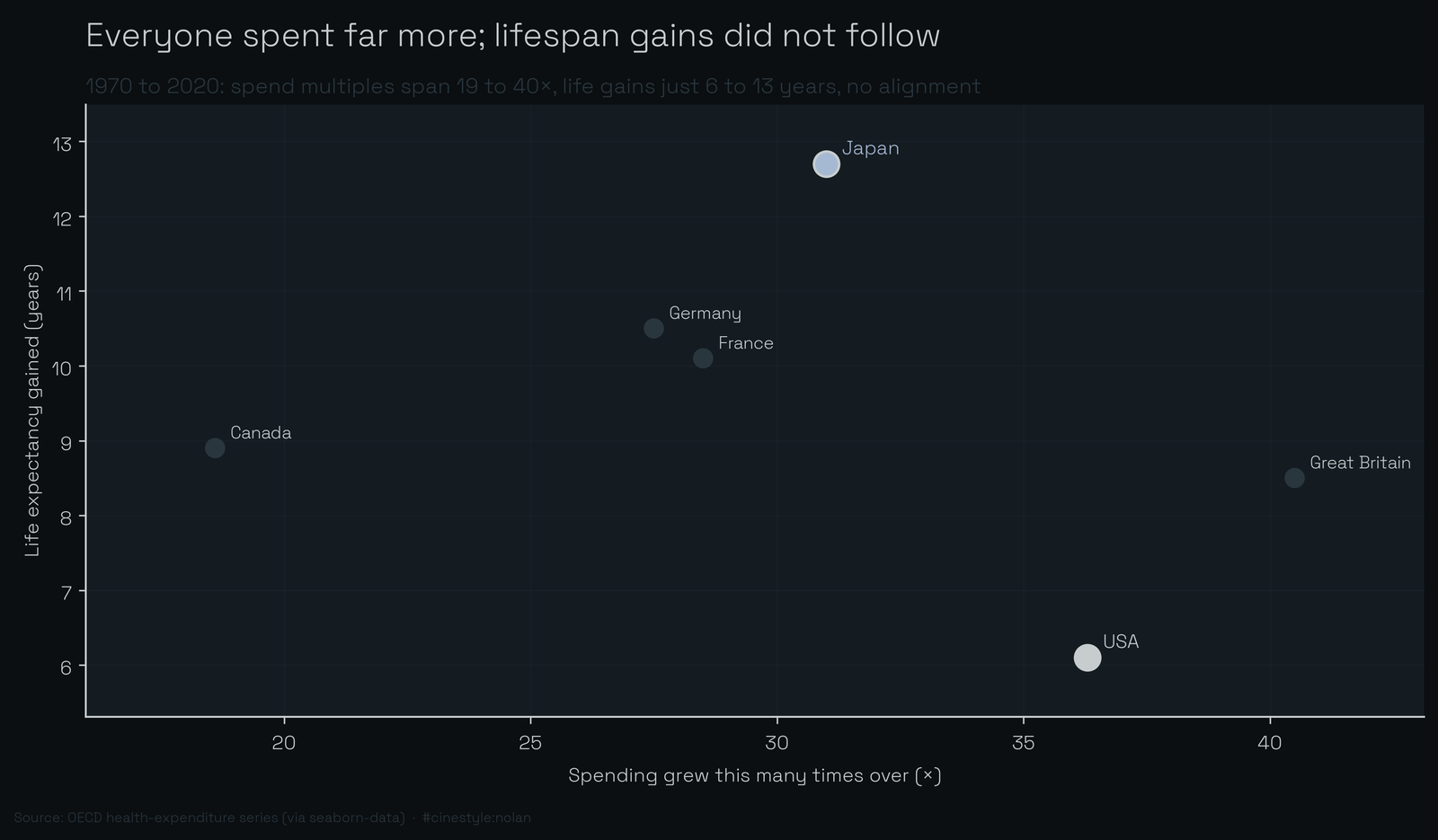
This last chart is the one I keep coming back to, because it is the one that surprised me. I expected the spending multiples to line up with the life-expectancy gains, spend more aggressively and gain more. They do not. The x-axis spans 18× to 40× and the y-axis spans 6 to 13 years, and the points are basically scattered. The country that grew its spending the hardest, Britain at 40x, gained 8.5 years. Japan grew spending the least and gained the most. Whatever drove a half-century of rising lifespan across these countries, the size of the checkbook was not it.
The bar that breaks the cleanest is the R²-comparison plot, linear at 0.34, log at 0.58. Even the better fit leaves 42% of the variance on the floor, and a chunk of what is left has a name and a flag.
So the headline holds, with an asterisk. More health spending does buy longevity, steeply at first, then with brutally diminishing returns. One country spends past the point where the curve has anything left to give, then keeps spending, and lands last anyway. The diminishing-returns story explains why the extra dollars stop working. It does not explain why the US is below the curve instead of merely flat on it.
That part is not in these four columns. Which is the honest place to stop.