// article
Gas Prices and Driving
For fifty years, gas prices barely changed how much Americans drove
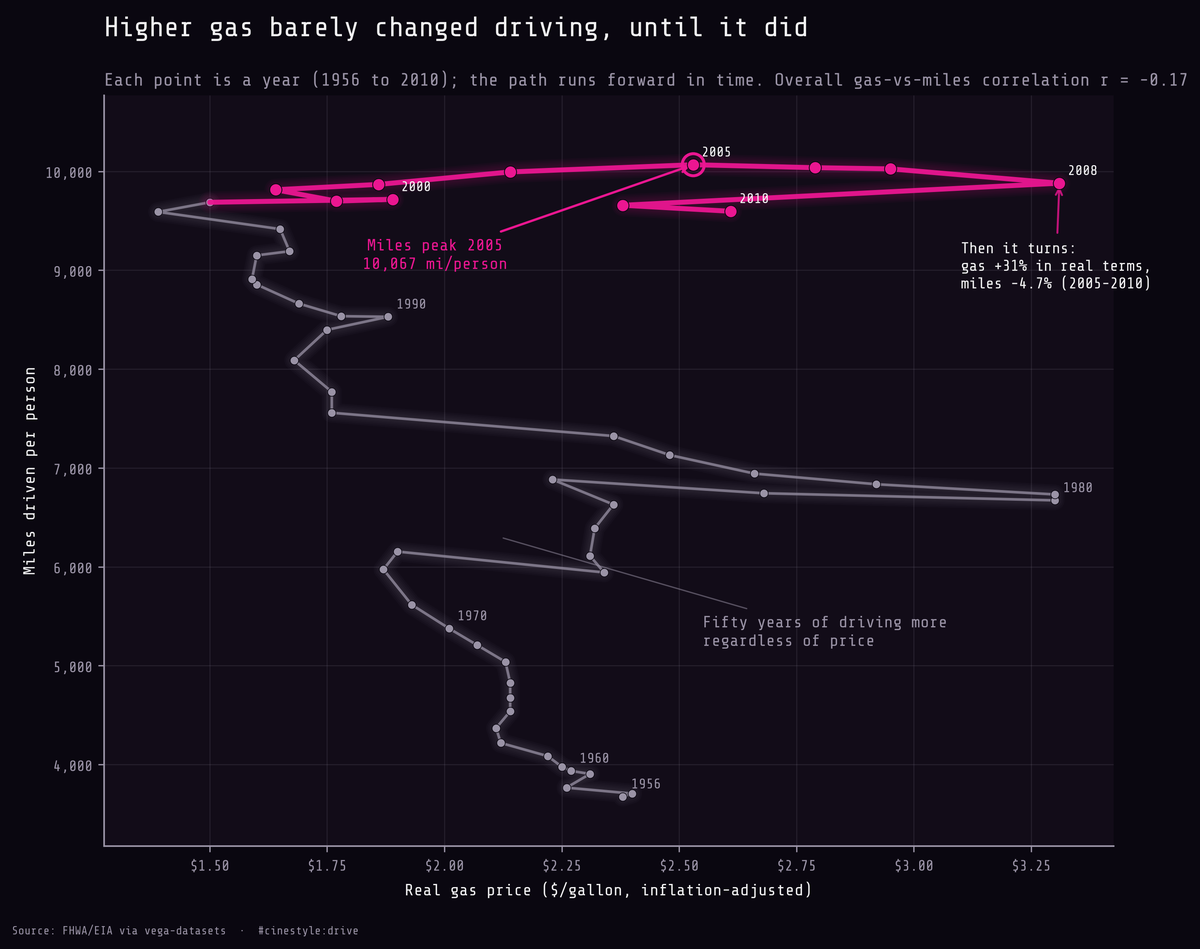
For fifty years, the price of gas barely changed how far the average American drove. The whole argument is one chart. Plot gas price against miles driven and let time draw the line. The path goes almost straight up: Americans drove more and more, and price barely bent the curve. Then, at the very top, it does something it never did below. It hooks. Miles peak in 2005, gas keeps climbing in real terms, and the line curls back down. That hook is the entire story, and the rest of this post is me deciding how much of it I believe.
Run the correlation across the whole series and you get -0.174. That is the number I started with, and it is almost nothing. Over 55 years of US data, the price of gas and how far the average American drove are basically uncorrelated (p = 0.20, so I cannot even rule out zero). If you walked in expecting “gas goes up, driving goes down,” the full-span number says you are wrong. It also tells you a lie.
The data is a small, clean table from the FHWA and EIA, distributed through vega-datasets: one row per year from 1956 to 2010, with per-capita miles driven and the inflation-adjusted price of a gallon of gas. Fifty-five rows. You can hold the entire series in your head at once, which is rare and a little dangerous, because a single summary statistic over a span this short reads as authoritative when it has no right to.
Here is what that -0.174 hides. Over the full span, miles driven per person went from 3,675 to 9,596, a 161% rise. People drove more and more, decade after decade, while gas wandered up and down in a fairly narrow real-dollar band. Miles trended up regardless of price, so a naive correlation mostly measures that secular climb against price noise and comes out near zero. The trend swamps the signal.
Split the eras and the sign flips
So I split the series. Gas was cheap and rangebound for a long time, then it was not. I put the cut at 2000, where the sustained real-price climb begins. Two regimes.
The cheap-gas era ran 1956 to 1999, 44 years. Within it, regressing miles on gas gives a slope of -2,082.6 miles per dollar, with r = -0.475 (p = 0.001). Negative and real. But read it carefully. This is not “expensive gas suppressed driving.” Gas drifted down in real terms across the decades while miles marched up: two trends crossing. The negative slope is almost an accounting artifact of secular growth meeting a flat-to-falling price. It is a descriptive within-era fit, not a price-elasticity estimate, and it tells me little about how drivers respond to the pump.
The price-spike era ran 2000 to 2010, 11 years. Here gas climbs from $1.64 to a real high of $3.31. And the within-era slope comes out positive: +109.4 miles per dollar, r = 0.354, p = 0.29. Not significant, and again just a descriptive fit. Which looks insane: gas doubled and driving rose with it. That is the regime change the overall number erased, but the positive sign is its own trap.
Why the spike-era slope is positive, and why it is still the bend
For the first half of that decade, gas and miles rose together. Gas was recovering off a 1998 low while the economy ran hot and people kept driving more. Both lines went up. A regression does not know which way causation points; it sees two rising series and reports a positive slope. That is the cheap-era trap, mirror-imaged.
The actual bend is at the end. Miles driven peaked in 2005 at 10,067 per capita, the highest value in the entire 55-year record. Then gas kept climbing. From 2005 to 2010 the real price went from $2.53 to its 2008 high of $3.31, up 30.8%, and miles fell 4.7%, from that 10,067 peak down to 9,596. Picture a driver who finally checks the per-mile cost and shortens the weekend trip. After half a century of “drive more no matter what,” the curve rolled over right when gas got genuinely expensive in real terms. But 2008 is also when the financial crisis hit, so I cannot hand the whole drop to the pump.
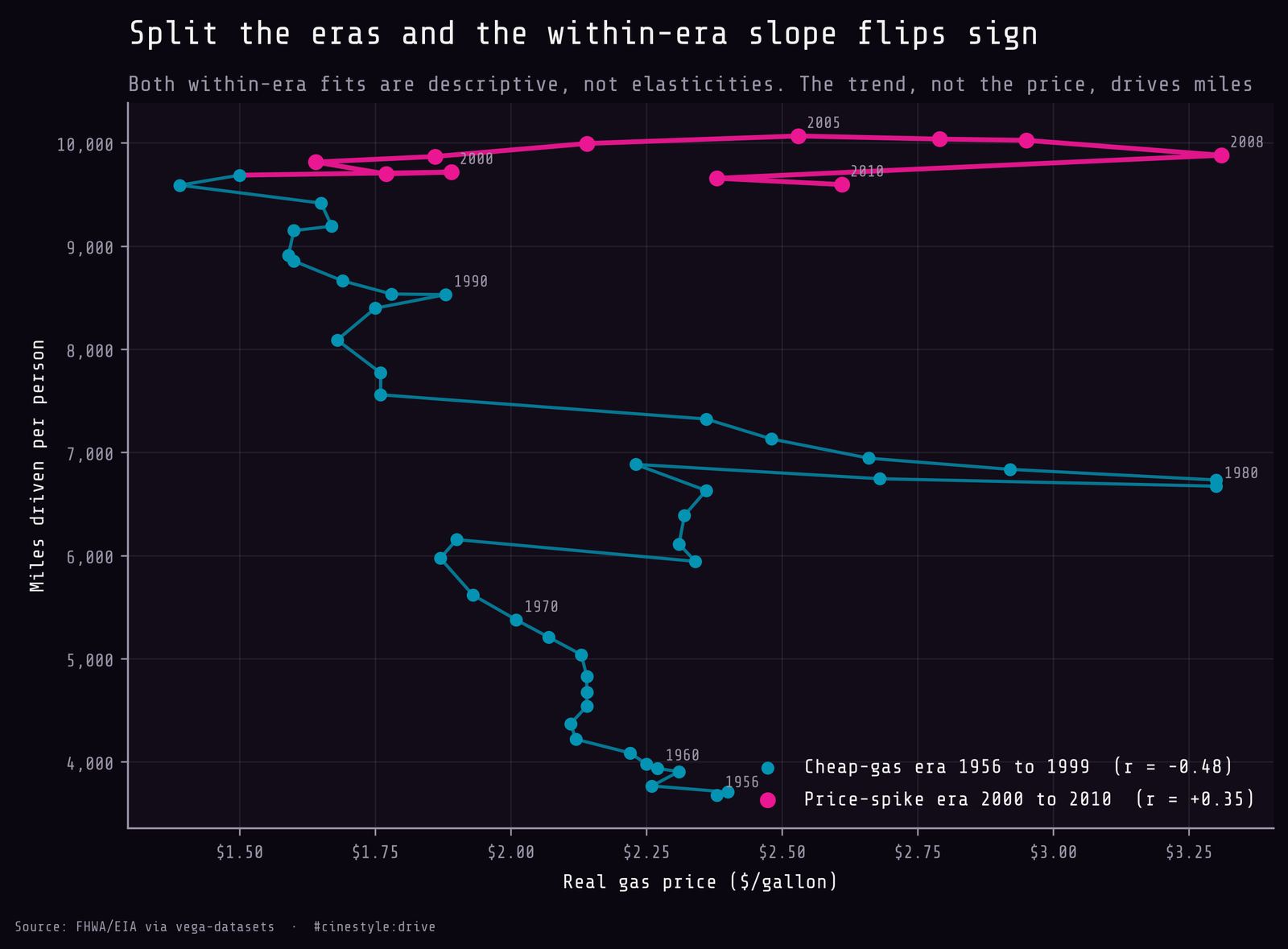
Color the same path by era and the two regressions are visibly fighting. The cyan path is the long cheap-gas climb, sloping gently down-and-right (r = -0.48). The pink path at the top is the spike era, sloping up-and-right (r = +0.35). Two descriptive fits, opposite signs, and neither is a price elasticity. Both are mostly the secular trend crossing the price axis at different angles. The hook in the top-right corner, 2005 out to 2008 and back down to 2010, is the only part about drivers actually responding to the pump, and it is the smallest part of the picture.
What is off about the chart, if I am honest, is how thin that hook is. The post-peak segment is six points. The spike era is eleven. I am reading a regime change off the last fifth of the data, and the spike-era correlation has a p-value of 0.29, which is to say not significant. The bend is real: it shows up cleanly in the raw miles series, peaking in 2005 and falling every year after through 2010. But calling the slope estimate precise would be overselling it. With n this small, one recession-shaped year moves everything.
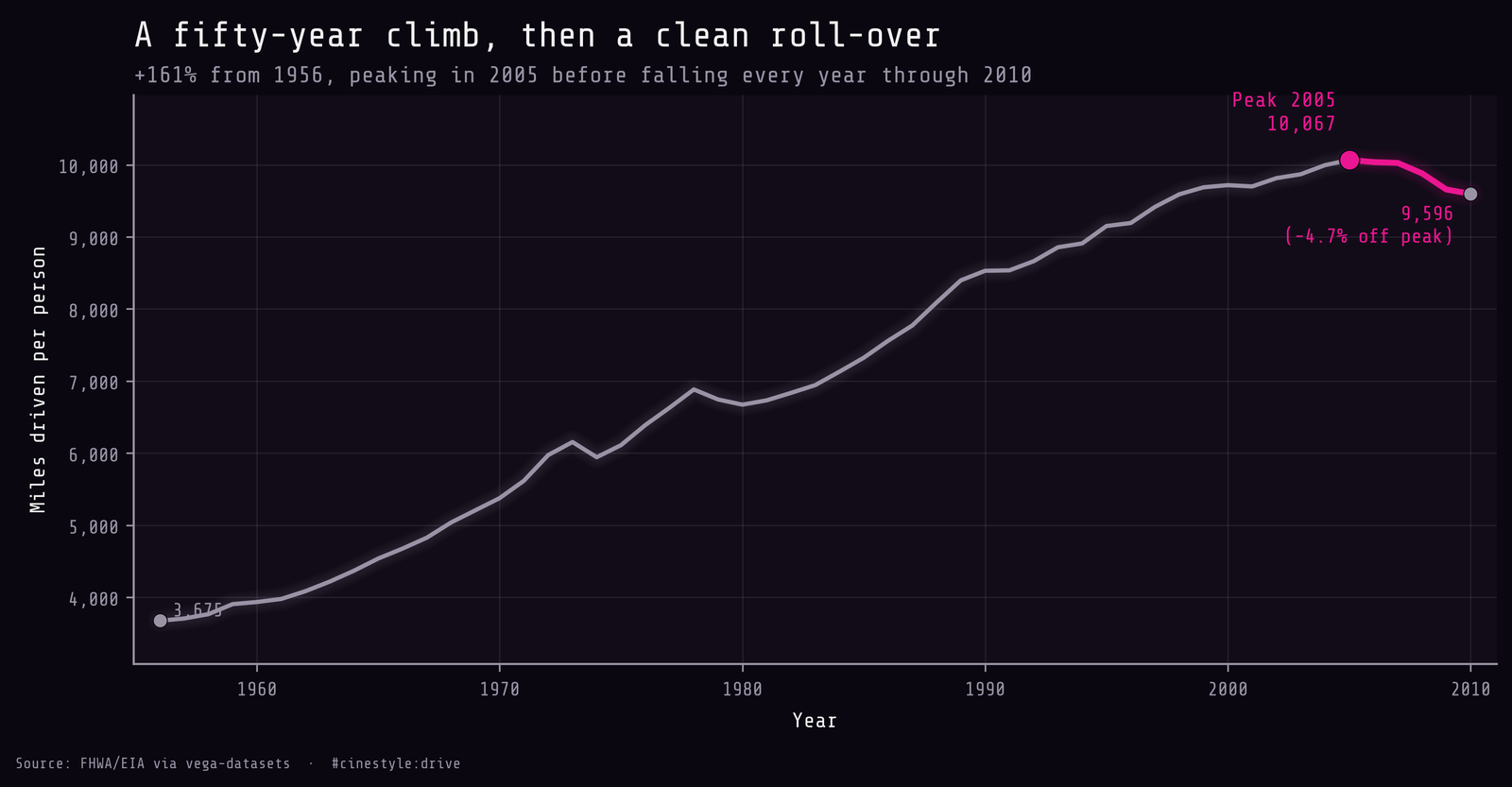
The miles-over-time plot makes the turning point hard to argue with, separate from any regression. A near-monotonic climb for fifty years, a clean peak at 2005, then a downhill run. No correlation needed. You can see the plateau and the roll-off.
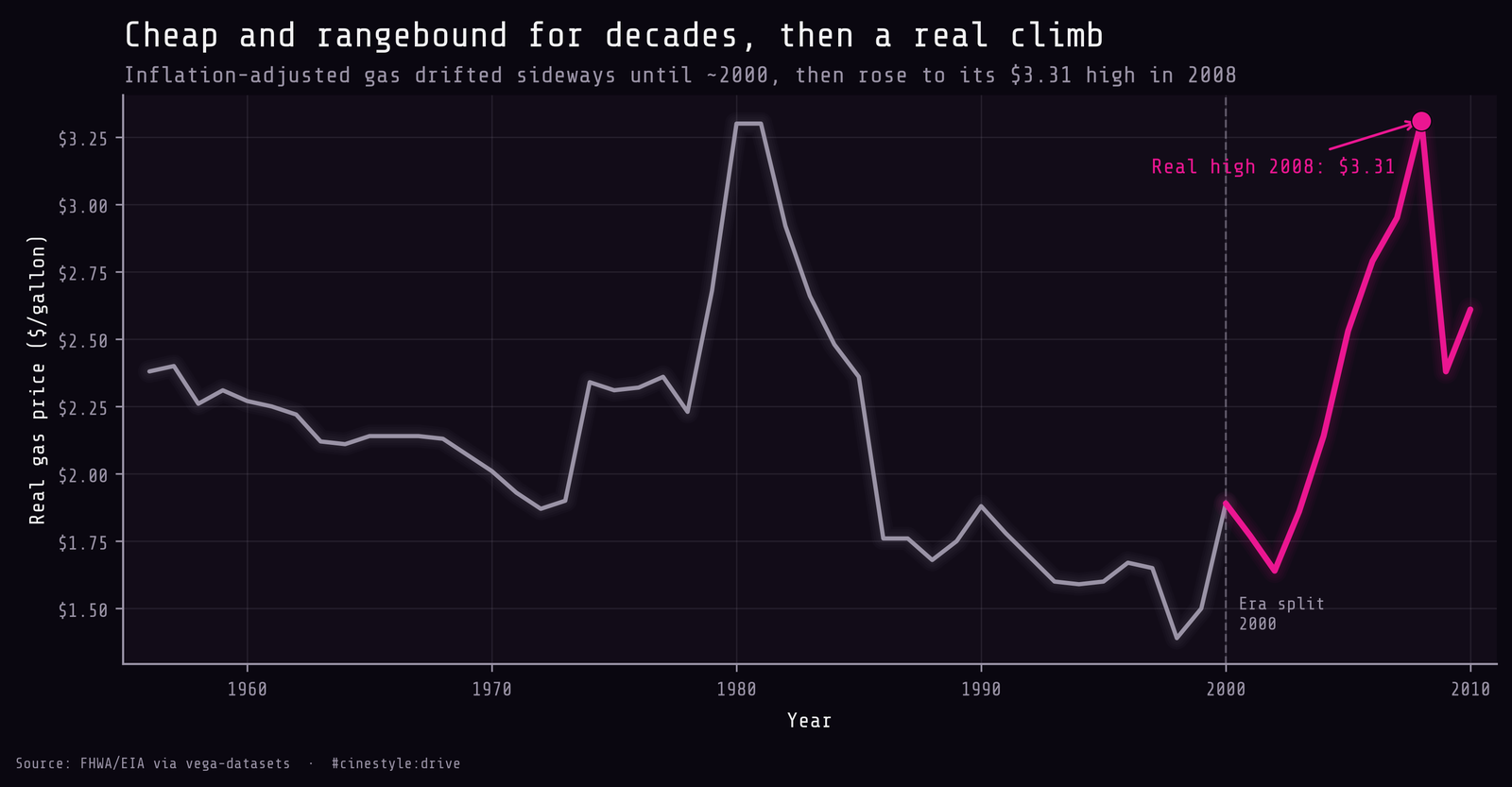
The price series shows why I cut the eras where I did: flat-ish and rangebound through the back half of the century, then a sharp real climb after 2000 to the 2008 high.
The caveat I will not bury: this is 55 annual observations of a national aggregate, gas is already inflation-adjusted, and correlation is not cause. Income, population, vehicle fleet efficiency, and a recession that landed right at the end all push on miles too, and I have controlled for none of them. The 2008 spike and the 2008 financial crisis arrive together, so I cannot cleanly separate “gas got expensive” from “people lost jobs and stopped commuting.” What I can say is narrow and, I think, solid. A single correlation over the whole span reads as roughly zero, and that zero is the average of a decades-long climb and a late bend pointing in opposite directions. The story was never one line.